Key takeaways
- A sharp image can still be weak evidence without location and sequence.
- Photo sets should document normal condition as well as defects.
- Remote review should state what the images cannot establish.
Source record
6 cited sources
Last verified
2026-08-21
Table of Contents
- Research question and scope
- Methodology
- The evidence layers
- Metadata and chain of context
- Completeness by scenario
- Fact versus inference
- Limitations
- Evidence-led conclusion
- Quick Overview
- Common Mistakes
- Common Questions Answered
- Can photographs prove a defect's cause?
- What should be excluded from a shared set?
- Ready to use this finding
Can a rental owner make a sound property decision from inspection photos alone? Sometimes a photo set is enough to confirm a visible condition, but a single sharp image rarely establishes extent, cause, timing, or code significance. This research asks what makes photographic evidence useful for rental portfolio operations, especially when an owner is reviewing a turnover, a maintenance closeout, a short-term rental reset, or a resident-reported concern without being physically present. Published August 21, 2026.
Research question and scope
The question is: which characteristics make a rental inspection image set decision-ready rather than merely persuasive? The scope is documentation quality and remote operational review. It does not replace an inspection by a qualified professional, prove habitability, determine responsibility, or authenticate a disputed image. The PortfolioRental audience needs a practical evidence standard that helps owners see what is known, what is missing, and what should happen next.
Methodology
I reviewed HUD housing quality standards, the International Code Council’s public information about model codes, NIST guidance on digital evidence and information integrity, the National Archives’ records management principles, the Federal Trade Commission’s privacy guidance, and IRS recordkeeping guidance. These sources were selected for condition standards, built-environment context, integrity, retention, privacy, and business records. I translated their shared themes into a photo-set model and tested it conceptually against four rental scenarios: move-in, turnover, maintenance completion, and remote follow-up. This is a documentation synthesis, not a forensic validation protocol.
The evidence layers
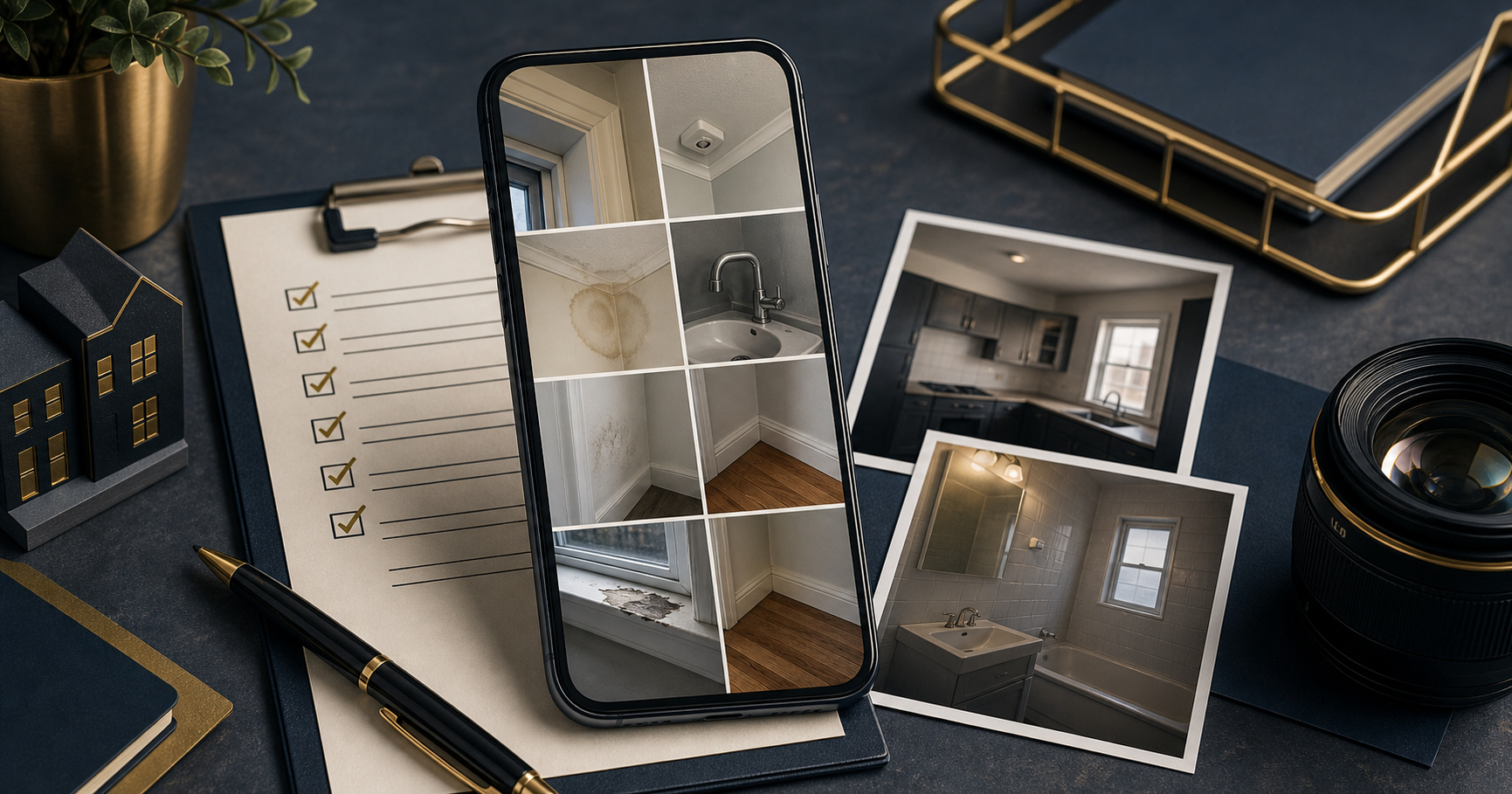
The first layer is orientation. A wide view shows the room or exterior context and helps identify where a detail sits. The second is identification. A closer view shows the surface, fixture, appliance, or component at issue. The third is comparison. A normal-condition image, adjacent area, measurement reference, or prior-period image can show whether the detail is isolated or part of a larger pattern. A fourth layer is sequence. Multiple images can show the path from the entry point to the affected area, particularly for moisture, damage, or a turnover condition.
Each layer answers a different question. A close-up may show a crack but not whether it extends across a wall. A wide image may show the room but not whether a valve is leaking. A before-and-after pair may show change but not cause. The record should not pretend that one image performs every function. A good set is intentionally redundant in a useful way: it reduces ambiguity while avoiding a flood of unrelated pictures.
Metadata and chain of context
Capture time, property, unit, room, and inspection purpose should be recorded outside the image when the system cannot reliably preserve metadata. A timestamp is evidence of capture context, not proof that the pictured condition began at that time. The source device, uploader, and any edits should be recorded when material. NIST’s information integrity work supports preserving provenance and identifying changes. For an ordinary operational review, that can be as simple as retaining the original file, recording who uploaded it, and noting whether it was cropped or annotated.
Privacy matters as much as clarity. Images can expose residents, children, documents, medication, account numbers, personal mail, or security information. The FTC’s privacy guidance supports limiting collection and protecting sensitive data. Before sharing a set broadly, crop or exclude unnecessary personal details, use approved storage, and retain only what the operational purpose requires. A beautifully organized photo library can still be unsafe if it captures more personal information than the decision needs.
Completeness by scenario
For move-in documentation, completeness means showing each relevant room, entry, fixture, appliance, and visible condition with enough context to compare later. For turnover, add the areas where furniture, linens, or stored items may have hidden evidence. For maintenance closeout, show the repaired component, the surrounding area, and a functional indicator where safe and appropriate. For a remote follow-up, show the reported symptom and the surrounding context, plus the date and condition at capture.
The same checklist should not be applied mechanically to every property. A furnished short-term rental may need turnover-specific views, while a long-term rental may need a more focused response to a service request. The inspection purpose should be visible in the record. That label helps an owner understand why a set contains certain views and prevents a partial set from being mistaken for a complete inspection.
Fact versus inference
The fact is what the image visibly shows: a darkened patch, a missing cover, a chipped surface, a closed valve, or a clear room view. The inference is that the patch is mold, the cover was removed by a resident, the chip is new, or the valve stopped a leak. Those inferences may require testing, history, a professional opinion, or another source. A disciplined note uses language such as “visible,” “reported,” “not visible,” and “not determined.” This is not timid writing. It keeps a remote reviewer from overstating what the evidence can carry.
An owner packet can pair each image with a short observation and a follow-up question. “Water staining visible below supply line; origin not established; verify above-floor connection” is actionable. “Bad plumbing” is not. The first statement routes the next investigation while preserving uncertainty. It also makes later comparison easier because the observation is tied to a location and a specific question.
Limitations
Photos cannot reliably establish hidden damage, odor, sound, temperature, moisture content, structural integrity, code compliance, or safe operation in every case. Lighting, lens distortion, camera angle, compression, and staging can alter perception. A photo set may be incomplete even when it is large. Remote review should therefore escalate when the decision concerns safety, a concealed condition, a disputed timeline, or a technical conclusion beyond the reviewer’s authority.
Evidence-led conclusion
Reliable inspection evidence is a designed set, not a collection of attractive images. It includes orientation, detail, comparison, sequence, location, capture context, privacy control, and a plain statement of limitations. For rental owners, that standard improves turnover review, maintenance closeout, and remote portfolio reporting without pretending a phone camera can replace an inspection. The evidence is strongest when it makes the next question clearer than the original complaint.
Sources: HUD Housing Quality Standards, International Code Council, NIST digital evidence guidance, National Archives records management, FTC privacy guidance, and IRS recordkeeping.
Quick Overview
Reliable inspection evidence combines orientation, detail, comparison, sequence, location, capture context, privacy control, and an explicit limitation. It is useful for turnover, maintenance closeout, and remote owner review, but it does not replace a qualified inspection. The maintenance backlog study applies the same fact and uncertainty discipline to repair queues.
Common Mistakes
A close-up without room context, a large photo dump without an inspection purpose, and an edited image without a retained original can all create false confidence. Another mistake is treating a timestamp as proof of when a condition began. Record what is visible, what is reported, and what remains undetermined.
Common Questions Answered
Can photographs prove a defect's cause?
Usually not. They can document a visible condition and its context, while cause may require testing, history, or professional assessment.
What should be excluded from a shared set?
Unnecessary personal documents, account details, medication, children, or security information should be excluded or protected when they are not needed for the decision.
Ready to use this finding
Label the inspection purpose, capture wide and detail views, preserve the original, record location and time context, and pair observations with the next verification question. The owner reporting cadence study helps place the resulting evidence in the right review rhythm.